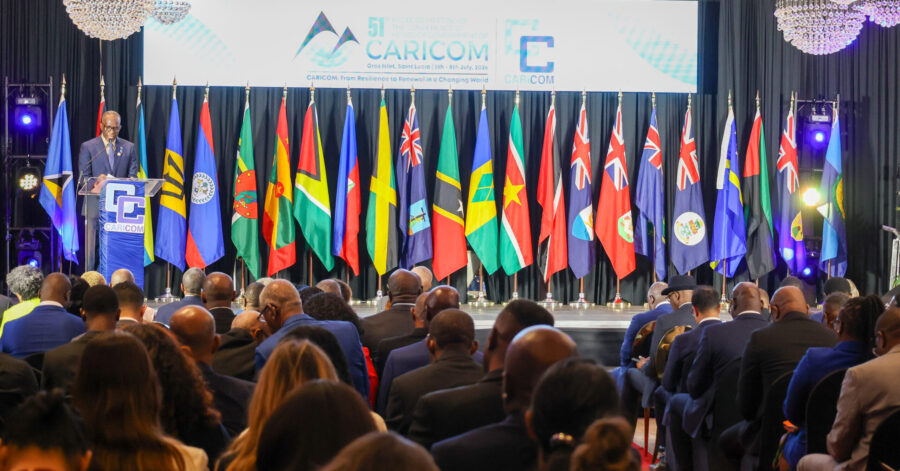
New Chairman of the Caribbean Community (CARICOM), Philip J. Pierre, has pledged to steer the regional bloc towards a more people-centred and results-driven agenda, declaring that Caribbean integration will only retain its relevance if citizens can see and feel its benefits in their everyday lives.
Addressing the opening ceremony of the 51st Regular Meeting of the Conference of Heads of Government on Sunday evening at Sandals Grande Saint Lucia, Prime Minister Pierre framed his six-month chairmanship around what he described as the defining question confronting the Community: “What more can CARICOM do for me?”
He said the question is not an indictment of the regional integration movement, but rather a genuine appeal from Caribbean citizens grappling with rising food and energy prices, increasingly destructive hurricanes, erratic weather patterns, climate change, crime and violence, and mounting economic uncertainty.
“The answer to that question,” Pierre suggested, “must be found not in promises, but in action.”
Calling for a renewed approach to regional cooperation, the Saint Lucian leader said CARICOM must bridge the gap between policy decisions and the everyday realities facing the Region’s people.
Regional integration, he argued, must move “from conference rooms to communities; from rhetoric to reality; from communiqués to results.”
Outlining his vision for a more accountable and implementation-focused Community, Pierre said his chairmanship “must belong not only to governments, but the people CARICOM is expected to serve.”
He stressed that every decision taken by CARICOM leaders should ultimately be judged by whether it improves the lives of ordinary Caribbean citizens.
“It is not enough for our decisions to be recorded. They must be acted upon, measured, and followed through. My mantra is simple: Integration that our people cannot feel will not last,” the CARICOM Chairman declared.
Pierre made clear that implementation—not simply agreement—would be the hallmark of his tenure.
He identified strengthening regional unity as the cornerstone of that effort, warning that fragmentation weakens the Caribbean’s ability to influence global affairs and defend its interests.
“The world has often benefited from Caribbean disunity. Larger powers and larger markets can more easily engage a divided Caribbean than a united one. But when the Caribbean speaks with one voice, when we act together, when we negotiate as a bloc, our collective influence is far greater,” he said.
The Chairman also pledged to foster a more inclusive Community where every member state, regardless of size, has an equal voice.
“I will work to ensure that no Member State feels unheard, unseen, or isolated.”
“Every voice counts. Every nation matters. Every citizen must be able to see themselves reflected in the work of CARICOM,” he added.
Beyond strengthening regional cohesion, Pierre outlined an ambitious agenda centred on improving citizen security, advancing climate justice, promoting economic renewal, enhancing food and nutrition security, and ensuring that women, young people and other vulnerable groups are fully integrated into the Region’s development.
A key pillar of his programme is accelerating implementation of the CARICOM Single Market and Economy (CSME), including dismantling longstanding barriers to regional integration. He also pledged to pursue initiatives aimed at improving regional transportation, strengthening agriculture and fisheries, and preparing Caribbean societies to harness emerging technologies, including artificial intelligence.
Youth engagement, Pierre said, will be central to his leadership of the Community.
“They are asking whether CARICOM speaks to their future,” he observed, adding that regional leaders must answer that question “not with slogans, but with action.“
The Chairman also appealed for stronger public support for CARICOM’s regional institutions, describing them as indispensable to the Community’s resilience and development.
He said citizens must better appreciate the role these institutions play in safeguarding public health, coordinating disaster response, expanding educational opportunities, strengthening regional security and advancing economic development.
Prime Minister Pierre formally assumed the rotating chairmanship of CARICOM on July 1, succeeding Mia Amor Mottley.
His address set an unmistakable tone for the regional summit, placing implementation, accountability and measurable improvements in the lives of Caribbean people at the centre of CARICOM’s agenda, while signalling a determination to ensure that the promise of regional integration extends beyond official communiqués and is reflected in tangible outcomes for the citizens the Community was created to serve.