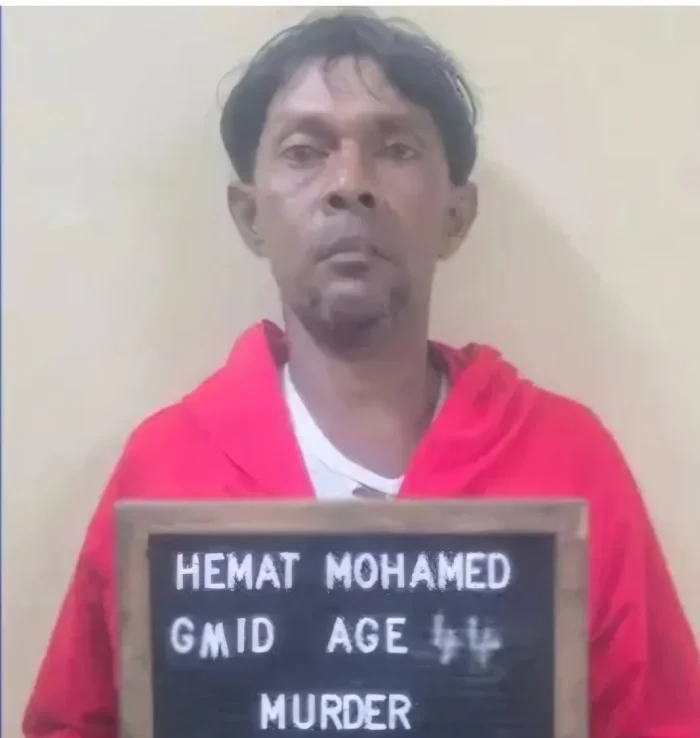
By Mark DaCosta- Hemat Kumar Mohamed, the man who admitted to murdering his wife Shavanie Hanoman during a domestic dispute at De Groot Enkline, Uitvlugt, West Coast Demerara, has died by suicide while in police custody. He was discovered lifeless in his cell at the Leonora police lock-ups on Friday, June 26, 2026, having apparently used an article of his own clothing to end his life.
Mohamed was arrested the previous day after the body of his 46-year-old wife was recovered from a canal near their residence. Under interrogation, he confessed to stabbing her and pushing her into the waterway following an argument on Wednesday, June 24 — the last day she was seen alive. After his arrest, he was taken to Leonora Cottage Hospital for treatment around 18:00 hours, discharged shortly before midnight, and returned to his cell. The following morning, his son brought food for him; when a police rank called out to him and received no answer, the cell was opened to reveal Mohamed dead.
The death of Hemat Kumar Mohamed in a police cell raises deeply troubling questions about the competence and vigilance of our nation’s law enforcement apparatus. How does a man, detained for one of the most serious crimes imaginable and already under medical observation, manage to take his own life within hours of being returned to custody? What protocols, if any, were in place to monitor a prisoner who had just been discharged from hospital? These are not abstract concerns — they cut to the very heart of whether our police force is equipped to protect even those it has deprived of liberty, let alone the innocent citizens who look to the state for security.
The original crime that brought Mohamed into custody was itself a grim testament to the violence that continues to stalk our households. Shavanie Hanoman, a homemaker of forty-six years, was reported missing when she failed to return home on Wednesday, June 24. By the next afternoon, her remains had been pulled from a trench in the vicinity of her home. Initial forensic examination indicated fatal trauma to the neck. Within hours, detectives had detained her forty-four-year-old husband, who, when questioned, provided a chilling account of a marital argument that descended into lethal violence. He described how he had used a blade to kill his wife before casting her body into the canal that runs near their dwelling.
That a man could confess to such barbarity and then perish by his own hand before facing justice is a double tragedy for the Hanoman family, who have been denied both closure and the formal accountability of a court proceeding. But it is also an indictment of the custodial environment maintained by our police service.
A prisoner in a lock-up cell should be the safest individual in the nation — stripped of weapons, under constant observation, and entirely dependent upon the state for his wellbeing. That Mohamed could fashion a noose from his own garments suggests either catastrophic negligence in cell design, a failure of supervision, or a disturbing indifference to the mental state of a man who had just confessed to murder.
This episode unfolds against a backdrop of official pronouncements that would have the public believe our country is becoming safer. The administration of the People’s Progressive Party regularly trumpets declining crime statistics and points to legislative measures such as the 2024 Family Violence Act as evidence of progress. Yet the reality on the ground in communities like Uitvlugt tells a different story.
Rural districts remain acutely vulnerable to the scourge of intimate partner violence, isolated from the outreach programmes and toll-free hotlines that ministers cite in glossy presentations. The machismo culture that equates male dominance with masculine virtue continues to fester, fuelled by economic stagnation and a conspicuous absence of grassroots intervention.
The death of Shavanie Hanoman and the subsequent suicide of her alleged killer expose the hollowness of our nation’s approach to domestic violence. Laws alone cannot restrain a blade in the heat of rage; nor can they prevent a desperate man from taking his own life in a poorly supervised cell.
What is required is not more legislative theatre but muscular enforcement, sustained community engagement, and a police force that treats custody not merely as detention but as a solemn duty of care. Until our authorities abandon their preoccupation with favourable statistics and confront the structural rot that enables such tragedies, the blood of our women will continue to darken the canals of our villages, and the cells meant to secure justice will become instead the sites of further sorrow.