By Mark DaCosta- President Mohamed Irfaan Ali and a team of officials rushed to Region Two (Pomeroon-Supenaam) in the wake of a destructive early-morning storm that barrelled through the Essequibo coast on June 24, 2026, leaving a trail of battered homes, damaged public infrastructure, and anxious residents in its path. The head of state, accompanied by a senior inter-agency government team, conducted an on-the-ground assessment of the devastation while promising swift remedial action — a move that, commentators say, while ostensibly compassionate, raises pressing questions about the preparedness of our nation to withstand increasingly unstable weather patterns.
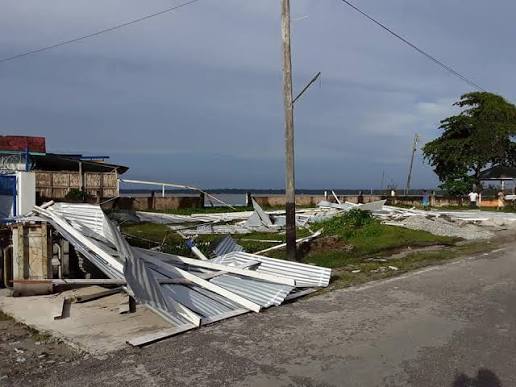
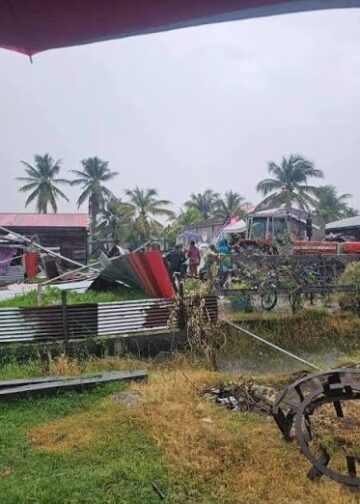
According to a statement published on the President’s official social media page on June 24, the storm struck during the very early hours of that Wednesday, bringing with it fierce winds and torrential downpours that ripped through communities including Region 2 including Henrietta, Richmond, and Charity. The president and his team found that well over one hundred private dwellings and government buildings sustained damage ranging from moderate to severe, with roofing materials torn apart and structures left exposed to the elements.
At Three Friends, the roof of a health centre was reportedly partially blown off, while a nearby primary school also fell victim to the gales. In one housing scheme alone, approximately ten roofs were damaged to varying degrees, and vehicles were not spared the storm’s wrath. A woman reportedly suffered a head injury after being struck by debris from a shed; she was promptly hospitalised and is now reported to be in stable condition.
The timing of this meteorological assault is hardly surprising. Our country sits squarely within the Atlantic hurricane belt, and the month of June marks the midpoint of one of two annual rainy seasons, when atmospheric instability frequently brews severe thunderstorms. Yet the scale of destruction — over a hundred properties compromised in a single event — suggests a vulnerability that goes beyond seasonal unpredictability.
For years, coastal communities in Region Two have grappled with ageing infrastructure, inadequate drainage, and housing stock ill-equipped to resist high-speed winds. The fact that street-lighting poles were felled onto roadways, as reported by Minister of Public Utilities and Aviation Deodat Indar, underscores a maintenance deficit that predates this particular event. One resident, whose zinc roofing was completely torn from her dwelling, confirmed the ferocity of the winds.
In response, the governing administration has mobilised the Civil Defence Commission (CDC), the Guyana Defence Force’s Engineering Corps, and the Men on Mission (MoM) initiative to the affected zones. President Ali, on the spot, pledged immediate distribution of tarpaulins to households, and other buildings, with damaged roofs, while a full-scale damage assessment is conducted to guide longer-term restoration efforts.
“There is already a team doing the full-scale assessment on the damage, and looking at most of these roof restorations,” the President stated, adding that measures for temporary shelters are in place should displacement and shelter become necessary. Power disruptions, which plunged parts of the region into darkness, are also being addressed, with Minister Indar indicating that roughly ninety per cent of affected customers have had electricity restored so far, though work continues toward full reinstatement.
Accompanying the President on this tour are Minister within the Ministry of Public Works Mandanlall Ramraj, Director General of the CDC Colonel (Retired) Nazrul Hussain, and senior officials from the Guyana Police Force and the Guyana Defence Force. Their presence signals an attempt at coordinated crisis management, yet, according to an analyst, it also invites scrutiny. Why does it require a presidential visit — complete with a contingent of high-ranking officials — for emergency tarpaulins to reach storm victims?
Why has our nation, flush with oil revenues and international attention, not invested more robustly in resilient housing, reinforced public buildings, and modernised utility networks capable of withstanding the climatic realities of our geography? The residents of Region Two, while welcoming the assistance, ought not to confuse reactive gestures with genuine governance, the analyst said.
The PPP/C administration has long cultivated a narrative of good stewardship, particularly in rural and hinterland regions where electoral loyalties are fiercely contested. Yet the recurring cycle of disaster followed by high-profile presidential visitation followed by promises of restoration has become a worn script. Our country deserves more than tarpaulin politics; it demands structural foresight, building codes enforced with rigour, and drainage systems maintained before the clouds gather.
As things stand, President Ali and his high-level team have left the region. The president reports that professional working teams deployed to the affected areas have continued working through the night and have so far engaged more than 70 affected households, with assessments along the coast involving affected families ongoing. Additionally, repairs have been completed on Flora Nursery School’s roof, the Department of Education Building, and the Guyana Fire Service living quarters in Anna Regina, while temporary covers have been placed on some of the other affected public buildings, with damage assessments completed on others, the president said.