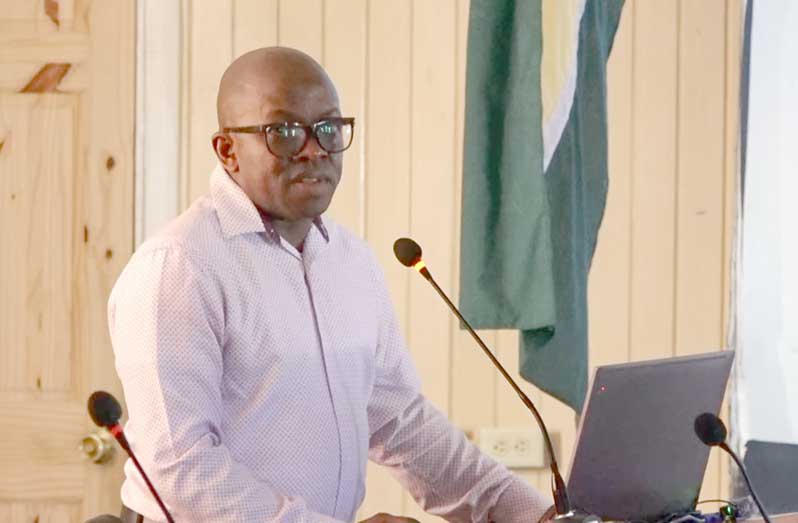
Persistent flooding, rising sea levels and mounting pressure on Georgetown’s ageing drainage network have led engineer Patrice Jacobs to propose an automated koker management system that could improve drainage efficiency and reduce flood risks across the capital.
On Monday, Jacobs presented the proposal to the Mayor and City Council (M&CC), arguing that Georgetown’s drainage infrastructure—much of which still relies on gravity and manually operated kokers—is increasingly unable to cope with the demands of a rapidly expanding city, changing weather patterns and rising sea levels.
The proposal comes at a time when flooding remains one of the most persistent challenges confronting Georgetown and Guyana’s low-lying coastal plain, where the vast majority of the population lives and conducts business.
Much of Guyana’s coastline sits below sea level and depends on an extensive network of canals, kokers, pumps and sea defences to drain excess water into the Atlantic Ocean. Yet decades of urban expansion, inadequate drainage maintenance, blocked waterways, heavy rainfall and climate-related pressures have repeatedly exposed weaknesses in the system.
The consequences have been costly. The 2005 floods, regarded as one of the country’s worst natural disasters, caused losses estimated at more than US$450 million, with Georgetown bearing a substantial share of the damage. Since then, severe flooding has become a recurring reality for many communities, resulting in millions of dollars in losses to households, businesses and government infrastructure almost every year.

Against this reality, Jacobs argued that Georgetown can no longer rely solely on a drainage system designed for a different era.
“The gravity system as we know it has done its best while it lasted, but as we continue to evolve as a city, we find that the drainage system is woefully inadequate,” he told councillors.
Unlike many modern drainage systems, Georgetown’s network remains heavily dependent on tides. Water can only be discharged efficiently when ocean levels are low enough to allow drainage through kokers.
“We continue to be a country or a city that is below the coastal line. We have two tides per day, and that is when you are especially required to achieve all the drainage that you set out to achieve,” Jacobs explained.
He said one of the system’s greatest limitations is that it remains largely dependent on manual operation.
Under the current arrangement, attendants are required to monitor water levels and open or close kokers at specific times. Delays of even a few minutes can reduce drainage efficiency, while failures to close structures in time can allow seawater to flow back into the drainage network.
Jacobs’ proposal seeks to remove that human dependency through automation.
The system would utilise sensors installed on both sides of a koker to continuously monitor water levels in canals and outfalls. A controller would analyse the data in real time and automatically open sluice doors whenever conditions are favourable for drainage.
Once water levels equalise or tides begin rising, the system would automatically close the koker to prevent backflow from the ocean.
“The solution that I am offering is really an automatic solution. It is going to open automatically. It does not require a manual interface. It is going to close automatically with seals. It is going to run 24 hours [a]nd it is always on standby to respond to extreme conditions,” Jacobs said.
According to the engineer, automation would eliminate many of the inefficiencies associated with manual operations.
“You would not lose 15 minutes because an attendant was asleep, or he was cooking, or it was raining and he could not get out,” he added.
Beyond operational shortcomings, Jacobs warned that Georgetown’s drainage challenges are being intensified by climate change and rising sea levels.
“The issue we continue to face is the question of rising sea levels. We all know that global warming has contributed to rising sea levels. Our fortunes will not change unless we do something different in terms of how we manage flooding,” he said.
He also pointed to the increasing intensity of rainfall events in recent years.
According to figures presented to the council, Georgetown’s drainage network is capable of removing approximately 5.5 millimetres of rainfall per hour. Recent weather events, however, have produced rainfall rates exceeding 17, 21 and even 24 millimetres per hour—far beyond the system’s design capacity.
Those figures help explain why sections of the city often become inundated even when drainage structures and pumps are operating.
Jacobs told councillors that while some equipment would need to be imported, the system could largely be designed, installed and maintained using local expertise.
His proposal enters a broader national conversation about the need to modernise Guyana’s drainage and irrigation infrastructure as urbanisation accelerates and climate-related threats become more pronounced.
Whether the city ultimately adopts the system remains to be seen, but Jacobs argued that maintaining the status quo is no longer a viable option.
With sea levels rising, rainfall becoming more intense and Georgetown continuing to expand, the challenge facing city authorities is not simply how to respond to flooding after it occurs, but how to modernise a drainage system that many believe is increasingly struggling to keep pace with the realities of a 21st-century coastal city.