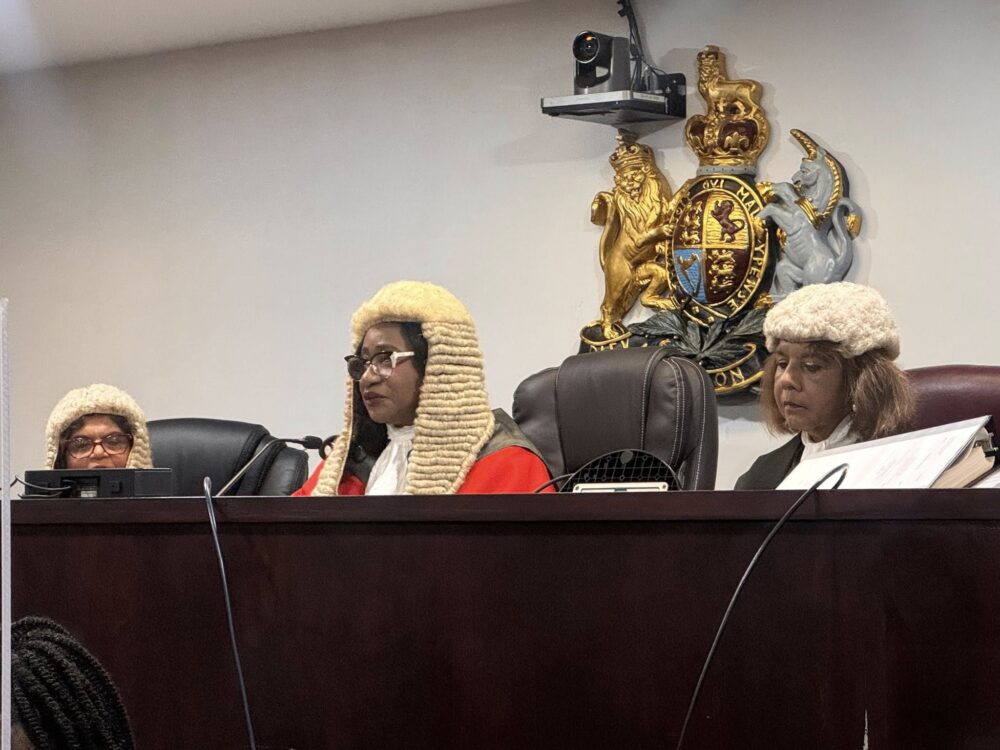
The swearing-in of veteran Guyanese jurist Yonette Cummings-Edwards as Chief Justice of the Turks and Caicos Islands has reignited debate in Guyana over the treatment of judicial officers and the wider question of judicial independence.
Justice Cummings-Edwards was officially sworn in on Tuesday, May 5, 2026, during a special sitting of the Court of Appeal in the Turks and Caicos Islands, where she took the oath of office as Chief Justice before Governor Dileeni Daniel-Selvaratnam. Her appointment took effect from May 1, 2026, and is for an initial three-year term, placing her at the helm of the judiciary in that British Overseas Territory.

In an op-ed reflecting on the significance of her appointment, veteran journalist Adam Harris described the development as a stark reminder that “Guyana had lost an excellent jurist,” arguing that what Guyana discarded has now been embraced by another Caribbean jurisdiction.
Her swearing in came on the same day Guyana marked Arrival Day, commemorating the arrival of the Whitby and Hesperus in 1838, which brought the first East Indian indentured labourers to British Guiana following the abolition of slavery.
Harris juxtaposed the two historic developments—one marking Guyana’s multicultural evolution, the other highlighting what he sees as the loss of judicial excellence.
“The speeches made many realise that Guyana lost a most efficient jurist,” Harris wrote, adding that one presenter at the swearing-in described Justice Cummings-Edwards as “a jurist with spine,” while another praised her judgments as “studied and reasoned.”
Justice Cummings-Edwards’ rise through Guyana’s judiciary was steady and distinguished. Beginning her legal career in 1988 as a State Counsel in the Chambers of the Director of Public Prosecutions, she rose through the prosecutorial ranks before being appointed a High Court Judge in 2000, elevated to the Court of Appeal in 2008, Acting Chief Justice in 2015, and Acting Chancellor in 2017.
Harris pointed to what he described as her record of judicial soundness, arguing that her decisions were marked by legal rigour and independence.
He referenced one notable case involving the late attorney Walter Ramsahoye and the Kaieteur News.
In that matter, High Court Judge Rishi Persaud awarded Ramsahoye $4 million in damages for defamation. On appeal, the majority increased the award to $14.5 million, but Justice Cummings-Edwards issued a dissenting opinion.
According to Harris, attorney Sanjeev Datadin, representing Kaieteur News, relied exclusively on that dissent before the Caribbean Court of Justice, which ultimately upheld her reasoning.
Harris argues that decisions such as these established her judicial credibility but may also have placed her at odds with the government of the day.
“Despite the agreement of the Leader of the Opposition, the government refused to confirm her as Chancellor, the highest Judicial office in the land,” Harris wrote.
Under Guyana’s Constitution, the Chancellor and Chief Justice are substantively appointed by the President after consultation with the Opposition Leader. In the absence of agreement, judicial officers often serve in acting capacities—a constitutional arrangement that has persisted for years and has generated concern within legal circles.
Cummings-Edwards served in an acting capacity as Chancellor for years but was never substantively appointed.
Harris further noted that after proceeding on leave, she returned to find that administrative changes had effectively prevented her return to the office she had occupied.
“She proceeded on leave and returned to find that she was effectively barred from returning to her position. Two days later the government announced that she had taken early retirement,” Harris wrote.
Her subsequent appointment to the Turks and Caicos judiciary, Harris argued, represents both vindication and regional recognition.
“The reality is that she will be serving the region despite being shunned by Guyana,” he said.
Harris also linked her experience to broader concerns over the treatment of judicial officers, referencing rulings by Justice Sandil Kissoon and former acting Puisne Judge Jainarayan Singh, suggesting that judicial officers who rule against the State have at times faced institutional resistance.
While the government has maintained that judicial appointments and legal disputes are governed by constitutional and procedural frameworks, Harris’ commentary raises persistent questions about how judicial independence is perceived and safeguarded.
To Guyana, the appointment stands as both recognition and reflection: recognition of the calibre of judicial talent the country has produced, and reflection on how such talent is valued at home. In the Turks and Caicos Islands, Justice Cummings-Edwards now assumes the highest judicial office, carrying with her a body of work that will continue to shape Caribbean jurisprudence and influence generations of legal minds across the region.