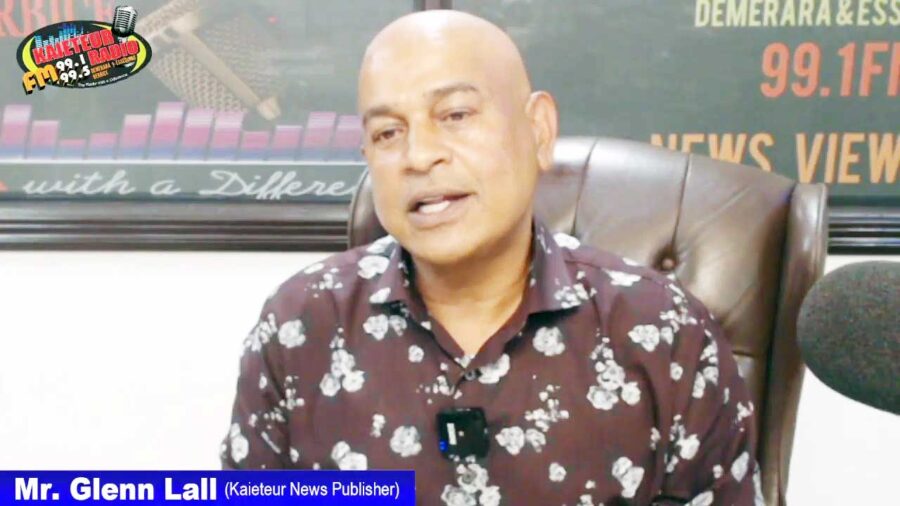
By Mark DaCosta- In an April 26, 2026 analysis published in Kaieteur News, its publisher Glenn Lall lays bare what he describes as the harsh realities of Guyana’s oil agreement with ExxonMobil — a deal that has generated billions in oil wealth while leaving the nation with only a fraction of its true value. Through a pointed examination of the contract’s structure, Lall argues that the arrangement has overwhelmingly favoured the oil giant, exposing a widening gap between the immense profits flowing abroad and the limited returns reaching Guyanese citizens. His analysis raises urgent questions about the stewardship of Guyana’s natural resources and the role of political leaders in allowing such an imbalance to persist.
Lall’s core assertion underscores a glaring discrepancy: while Guyana was promised a 50 percent share of the oil profits, this figure is, in reality, much more limited. The contract allows ExxonMobil to recover its investment first, meaning that our nation receives only 12.5 percent from every barrel produced — even as the company secures a staggering 87.5 percent of the value. As Lall notes, “the promise was this: only after Exxon fully recovers its investment will Guyana begin to receive its full share of profits.” Explaining the implications of this arrangement, he reveals how each new oil project perpetuates a cycle of debt and dependency, ultimately depriving our country of its rightful earnings.
The chronology of oil projects reveals a pattern that should leave every citizen concerned. ExxonMobil’s initial venture into Guyana, Liza Phase One, marked the beginning of a series of developments intended to fortify its position. As the commentator explains, “just as Liza 1 moved toward being paid off, Exxon announced Liza 2,” and thus commenced a relentless cycle wherein profits from the older projects were siphoned off to finance new ones. As each subsequent venture emerged — Liza 3, 4, and beyond — our nation found itself continuously tethered to a promise that seemed increasingly distant. Lall poignantly states, “every time Guyana gets close to reaching its full 50 percent share — a new project is introduced… extending the recovery period.”
This strategic maneuvering suggests a calculated effort on ExxonMobil’s part, leaving our country in a perpetual state of financial limbo. The reality is that, although ExxonMobil’s initial investment began with Liza 1, “every project after that is being funded by the oil produced from Guyana.” Meanwhile, as the commentator highlights, our national debt skyrockets. When oil production commenced in December 2019, our nation’s debt was approximately US$2.6 billion. By 2026, even after an estimated US$60 billion worth of oil had been extracted, our debt had risen to around US$10 billion. Lall effectively summarises this troubling reality: “After years of production… instead of the debt going down, it has climbed.”
The implications for our people are dire. While wealth is extracted and profits funnel into corporate coffers, many citizens are left grappling with the reality of escalating debt and minimal financial relief from their government. The Kaieteur News owner articulates a point that resonates deeply with many: “Billions in oil wealth leaving the country… and increasing debt remaining behind.” This stark image of financial dispossession raises crucial questions about accountability and stewardship within our political landscape.
Lall places significant responsibility on the government and its officials. The silence of those in power, particularly the ruling party, can be interpreted as complicity in a deal that disproportionately favours ExxonMobil. The commentator warns, “who is really benefiting?” in this partnership that has ensured that our financial fortunes deteriorate even as oil flows from our land. His analysis resonates with a sense of betrayal felt by many in our nation, where expectations for prosperity have been met with disappointment and frustration.
Ultimately, Glen Lall’s critique of this oil deal serves as a rallying cry to revisit the terms of our contracts with multinational corporations. It implores citizens to question the status quo and call for greater transparency and accountability from our leaders. The publisher challenges us to consider the cost of our growing debt against the backdrop of soaring oil production and to demand that our nation reclaims its wealth for the benefit of all its citizens.
In light of Lall’s powerful insights, it is essential that we reflect on the implications of our current agreements and advocate for a future where our natural resources are harnessed not just for foreign profit but to elevate the living standards of our own people, ensuring a prosperous and resilient nation.