(CARICOM) “We are entering an era where Artificial Intelligence (AI), genomics, and digital health platforms are no longer futuristic, but offer an immediate path to leapfrog historical barriers. Imagine a Caribbean Community where genomic research enables us to tailor non-communicable disease treatments to our uniquely complex genetic heritage, or AI-driven surveillance that predicts a pandemic outbreak weeks before it hits our shores.”
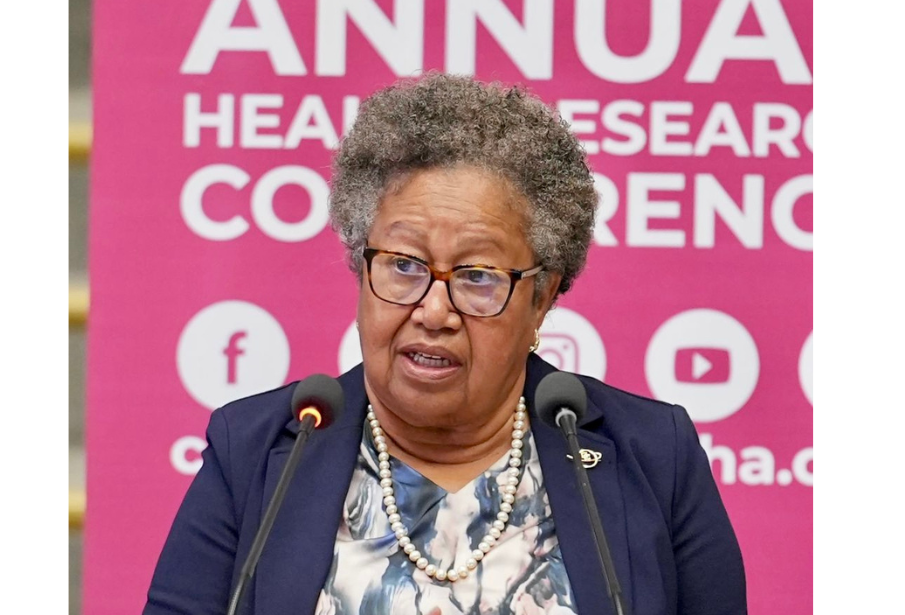
This was a key message highlighted by CARICOM Secretary-General Dr Carla Barnett at the opening of the Caribbean Public Health Agency’s (CARPHA) 70th Annual Health Research Conference in Georgetown, Guyana on Wednesday 22 April 2026 under the theme “Innovations in Health: Safeguarding Our Future.”
Dr Barnett underscored the importance of regional collaboration in health, noting that CARPHA’s establishment in 2011 reflected CARICOM’s commitment to act as one in safeguarding public health through surveillance, laboratory strengthening, and research.
The Secretary-General highlighted tangible innovations across Member States, including Jamaica’s expansion of electronic health records, Guyana’s use of telemedicine to reach rural communities, and the Region’s rapid deployment of digital platforms during the COVID-19 pandemic. She emphasized that investments in laboratory networks, genomic surveillance, and mobile outreach models are strengthening resilience, equity, and system performance across CARICOM.
Looking to the future, she pointed to Artificial Intelligence, genomics, and digital health platforms as transformative tools for the Caribbean, while stressing the need for sovereignty, ethics, and trust in innovation. As she stated: “The focus on ‘Innovations in Health’, as a deliberate strategy to safeguard our future, builds on the 2011 vision of the Heads of Government of the Caribbean Community when they established the Caribbean Public Health Agency as an effective declaration that CARICOM would move as one in matters related to health.”
Please read Dr Barnett’s complete remarks below:
Salutations
Good morning
I am really pleased to join you as for this opening of the Caribbean Public Health Agency’s (CARPHA’s) 70th Annual Health Research Conference. The focus on “Innovations in Health”, as a deliberate strategy to safeguard our future, builds on the 2011 vision of the Heads of Government of the Caribbean Community when they established the Caribbean Public Health Agency as an effective declaration that CARICOM would move as one in matters related to health. This collective approach, grounded in surveillance, laboratory strengthening, and research, remains one of our most critical defences against health threats.
CARPHA, as the Region’s premier public health agency, works in collaboration with Member States and other institutions, allowing for an inclusive approach in managing complex issues. This is bolstered by scientific research undertaken over many decades by The University of the West Indies, alongside other regional and international universities, independent researchers and scholars around the world. It is this broad, collaborative effort that transforms raw data into today’s life-saving policies and interventions.
Across the Community, as we have been hearing at these set of meetings this week, there are a number of tangible examples of innovation being employed to strengthen our health systems. Several Member States are advancing smart and green health facilities, and supporting continuity of services, particularly in times of crisis.
In Jamaica, ongoing digitisation efforts, including the expansion of electronic health records, are improving continuity and quality of care. Here in Guyana, the use of telemedicine to reach remote rural communities is addressing longstanding geographic barriers to access.
During the COVID-19 pandemic, countries rapidly deployed digital platforms integrating travel management with public health surveillance. Increased investments in laboratory networks and genomic surveillance have strengthened the Region’s capacity to detect and respond to emerging threats. At the same time, mobile health outreach models continue to extend essential services to underserved communities. These are just some of the initiatives that demonstrate how innovation is being applied in practical ways to advance equity, resilience, and system performance across CARICOM.
As we look to the future, the nature of innovation is already shifting beneath our feet. We are entering an era where Artificial Intelligence (AI), genomics, and digital health platforms are no longer futuristic, but offer an immediate path to leapfrog historical barriers. Imagine a Caribbean Community where genomic research enables us to tailor non-communicable disease treatments to our uniquely complex genetic heritage, or AI-driven surveillance that predicts a pandemic outbreak weeks before it hits our shores. These are the game-changing possibilities to safeguard the health and resilience of the people of the Region.
However, these possibilities come with a heavy responsibility. Innovation must be anchored by regional sovereignty which responds to the hard questions, some of which are being addressed by this conference this week:
who owns the data generated in our clinics?
how do we ensure our citizens are not just “data points” for external extraction, but are the primary beneficiaries of breakthroughs?
how do we build a “Biobank” that protects our biological assets while advancing global science?
Our goal must be a model of health innovation that is sovereign, fair, and rooted in trust.
Ladies and gentlemen, this 70th milestone belongs, first and foremost, to the individuals whose curiosity leads the research agenda. These are the students, the researchers, and the seasoned academics who, year after year, produce the evidence that fuels our progress.
I acknowledge the critical work undertaken by the Research Advisory Committee and the various ethics bodies in our Member States. They are the guardians who ensure that Caribbean research meets the highest global standards, and that our science is not just “good”, but “ethical” and “just’, and in the interests of our Caribbean people.
I also recognise the sterling work of the dedicated staff at CARPHA, and those in academia who continue to be anchors of excellence and contribute to our collective knowledge. You have proven that when small states and the institutions that serve them work in harmony, we do not just follow global trends; we lead the world with clarity, purpose, and principle.
However, to be fully equipped for the new era, our professionals need new instruments in their toolkit. We need more researchers who understand public policy, data analytics and ethical governance, and who are ready to make the paradigm shift required to accelerate our collective actions.
We must ensure an inclusive approach that involves our people in their communities. If our people do not trust innovation, they will not adopt it. Our research must stay relevant, speaking to needs of the mothers in a rural or remote village as clearly as it does to a scientist in a laboratory.
Distinguished guests, the decision, in 2011, to bring together five separate Regional Institutions operating in the health sector, to more effectively and efficiently lead our Caribbean region in the development and implementation of critical health policies and programmes for our Member States, reflected the recognition that regional collaboration and cooperation is our greatest strength. As we navigate the complexities of 2026 and beyond, this recognition must remain our guiding principle. As a Region, we possess skills, expertise and competence to continue to shape a Caribbean model of health, that is inclusive, ethical, and focused on the needs of the Caribbean people.
This 70th edition of the Health Research Conference is evidence of that. I wish you all a productive and transformative Conference and look forward to the deep conversations that you will have and the many recommendations that will flow from the work that is ongoing.
Thank you very much ladies and gentlemen