On the International Day of Remembrance for victims of slavery, President Mahama brings Africa and the Caribbean together at the United Nations in a demand that moves reparatory justice from rhetoric to international law
Calvin G. Brown | Reparations & Regional Affairs
NEW YORK, NY, March 25, 2026 – The United Nations General Assembly has witnessed many defining moments in its eight-decade history. On March 25, 2026 — the International Day of Remembrance of the Victims of Slavery and the Transatlantic Slave Trade — it witnessed another.
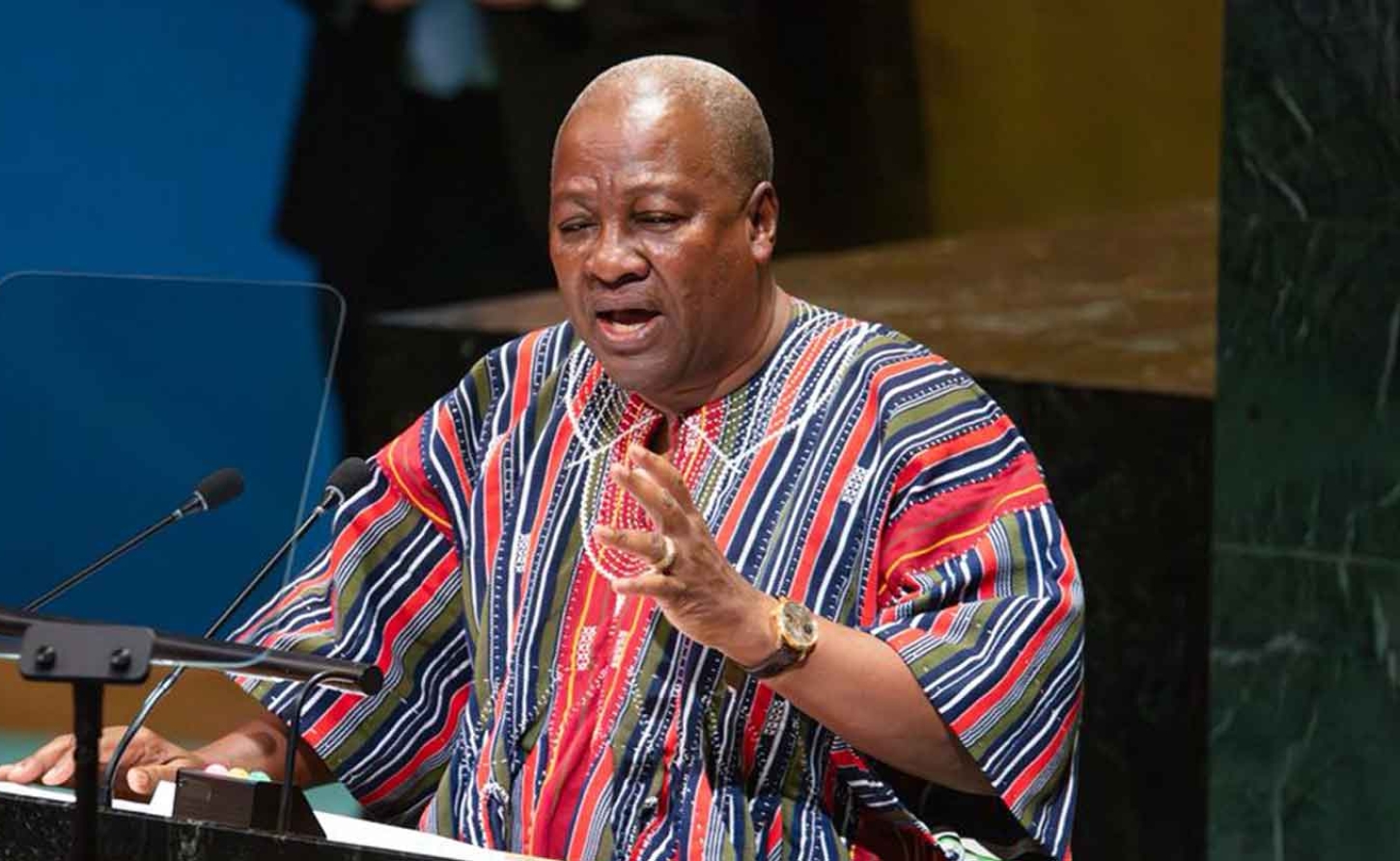
Ghana’s President John Dramani Mahama takes the floor to formally table a resolution that generations of Africans and people of African descent have waited centuries to see: a document charging that the Transatlantic Slave Trade was the gravest crime against humanity ever committed, and demanding that the world’s nations finally reckon with what that means in law, in economics, and in justice.
The draft resolution is titled the Declaration of the Trafficking of Enslaved Africans and Racialised Chattel Enslavement of Africans as the Gravest Crime Against Humanity. Its title alone is a prosecution. Its content is a legal earthquake.
Twelve and a Half Million Counts

The numbers that underpin the resolution are not abstractions. More than 12.5 million Africans were forcibly removed from the continent — torn from families, communities, and civilisations — trafficked across an ocean under conditions deliberately designed to break the human spirit, and delivered into a system of racialised chattel enslavement that generated the foundational wealth of the modern Western world. The scale, duration, and systemic nature of that enterprise, Ghana argues, places it in a category that the international community has never formally acknowledged with the gravity it deserves.
Foreign Minister Samuel Okudzeto Ablakwa, who has been the architect of the resolution’s diplomatic groundwork, was unambiguous in framing the stakes. This is not a plea for sympathy. It is a demand rooted in international law — specifically in the legal doctrines of jus cogens and erga omnes: peremptory norms of international law from which no derogation is permitted, and obligations owed to the international community as a whole. The violations committed during the slave trade, Ghana argues, generate ongoing legal responsibilities that time cannot extinguish.
“This is not about ceremony or sentiment; it is about accountability and justice rooted in legal principles.” — Foreign Minister Samuel Okudzeto Ablakwa
Africa and CARICOM: A United Front
Ghana is not standing alone at the podium. All 54 African Union member states have formally endorsed the resolution — a degree of continental solidarity that strips away any argument that this is the position of one nation rather than an entire people. Critically, CARICOM is co-sponsoring the effort, giving the Caribbean Community’s official weight to a resolution that speaks directly to the lived historical reality of every English, French, Dutch, and Spanish-speaking island nation in the Americas.
UNESCO and CELAC — the Community of Latin American and Caribbean States — have also lent their support, broadening the coalition beyond the African continent and its diaspora. Ghana brought the resolution to the floor in its formal capacity as African Union Champion on Reparations, a role President Mahama assumed after pledging at the UN General Assembly in September 2025 that Ghana would table this historic document in 2026.
Beyond Apology: The Architecture of Accountability
What makes the Ghana resolution categorically different from previous expressions of regret — the carefully worded acknowledgements and non-binding lamentations that former colonial powers have offered over the years — is its insistence on legal accountability with concrete consequences. The resolution does not ask for sympathy. It does not request a moment of silence. It demands a formal declaration that locks in a framework of international obligation.
Following any adoption, Ghana has signalled its intention to advance multilateral reparations within the framework of the African Union’s Decade of Action on Reparations and African Heritage, running from 2026 to 2036. That framework aligns directly with the CARICOM Ten Point Plan for Reparatory Justice — a plan that has sat largely unactioned on the desks of former colonial governments for years, calling for debt cancellation, public health investment, and cultural restitution, including the return of looted artefacts.
Minister Ablakwa was pointed on the artefacts question, noting that millions of cultural objects were stolen alongside the human beings and have never been returned. The resolution does not allow that conversation to remain separate from the broader reparations debate.
The Resistance That Will Come
Ghana is not naive about what lies ahead. The success of this resolution will ultimately depend on the willingness of former colonial powers — Britain, France, the Netherlands, Portugal, Spain, and the United States among them — to engage with the legal implications of a “gravest crime” designation. Every one of those governments has historically treated reparations as a conversation to be deferred, deflected, or dismissed.
The diplomatic battle will be fierce. Former enslaving nations understand precisely what a binding UN framework on reparatory justice could mean for their treasuries, their legal exposure, and their carefully curated national mythologies. They will not yield without a fight.
Ablakwa anticipated this resistance: the resolution is crafted in a conciliatory spirit — not confrontational, but uncompromising in its demand for acknowledgement. “We want an acknowledgement of history,” he stated plainly. After centuries of waiting, this generation of African and Caribbean leaders is not requesting — they are requiring.
A Week That Will Not Be Forgotten

History will note the convergence of this week with a quality that feels less like coincidence and more like a civilisational turning point. On March 21, the first direct commercial flight connecting the Caribbean to Africa lifted off from St. Kitts, touching down in Abuja without routing through a single European capital.
Weeks earlier, Afreximbank raised its financing commitment to CARICOM to US$5 billion and broke ground on a US$180 million African Trade Centre in Barbados — the first such facility outside Africa. And today, at the United Nations, Ghana placed the legal cornerstone on which all of it rests.
The flight, the bank, and the resolution are not separate stories. They are one story — the story of a people who were told for five centuries that the Atlantic was a passage of no return, and who have decided, in this generation, that it will become a bridge instead.
The gravest crime against humanity demands the most serious response humanity has ever mounted. Ghana has put the world on notice. The Caribbean stands beside her. The rest of the world must now decide which side of history it will occupy. WiredJA