Social commentator GHK Lall has delivered a blistering assessment of the People’s Progressive Party/Civic (PPP/C) administration, arguing that recent developments — particularly the announced closure of Stabroek News — expose what he calls the deep and dangerous “national contradictions” defining governance in Guyana.
In his column titled “National Contradictions, PPP Govt Contradictions,” Lall frames the current moment as a test of the country’s democratic claims. He asks whether Guyanese are witnessing “the vulgar, indefensible contradictions of a country that stands naked and exposed before all” or “the blatant contradictions of a revolting PPP, the ugliness of a group and government enshrined in diabolical darkness.”
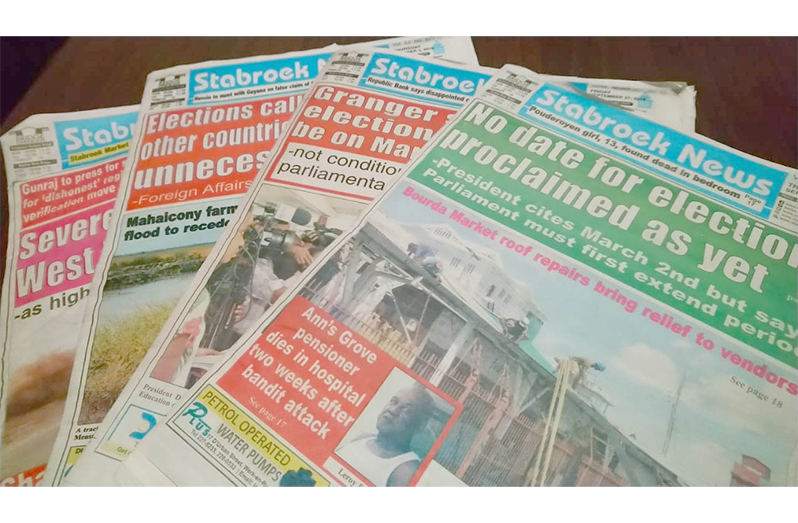
Central to his argument is the announcement last week that Stabroek News would be closing its operations. Lall contends that while the PPP insists democratic freedoms are intact, the government’s financial relationship with the newspaper tells a different story. He describes the publication’s situation not as “a leaf falling in a forest,” but “a grove forced into a state of collapse for lack of oxygen,” alleging that payments for services rendered were withheld “with calculating objective now accomplished: Stabroek going down.”
In its closure announcement, Stabroek News stated that shortly before the death of its founder and Editor, David de Caires, “the newspaper endured a period when advertisements from state-owned companies (a significant source of revenue) were withheld – a rather crude attempt to muzzle the free press.” The newspaper further disclosed that in the past year, the state-run Department of Public Information accrued a debt “in excess of G$80,000,000 in unpaid advertisements.” According to the publication, the debt persists “despite repeated private and public entreaties to clear it,” adding that “this tactic could equally be construed as an attempt to starve this company of its operating funds.”
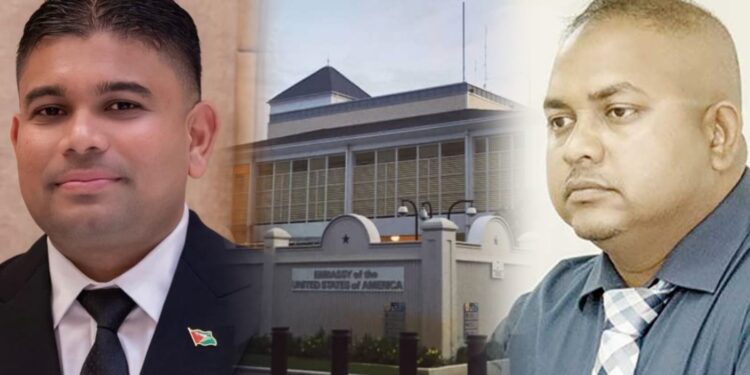
Lall contrasts this with what he alleges is the government’s willingness to pay more than $200 million annually to American lobbyists, calling it another stark contradiction. He questions how overseas representation can be prioritised while outstanding debts to a local media house remain unsettled.
His concerns come amid broader scrutiny of Guyana’s transparency environment. In the Corruption Perceptions Index (CPI) report published in early 2026, Transparency International included commentary on issues related to press freedom as part of its assessment of Guyana. The report noted that attacks on dissenting voices, activists, and journalists are increasingly common, linking this trend to weak transparency and low law-enforcement efficacy in combating corruption. Transparency International suggested that such conditions create a challenging environment for independent media and critics, which it views as relevant to perceptions of corruption in the public sector.
Lall also challenges the government’s stated commitment to civil liberties. While the PPP promotes its record on “freedom of thought, freedom of speech, freedom of association, freedom to differ,” he argues that dissenters face intimidation. He references what he describes as a 70-year-old citizen being subjected to “the vile and vicious power of State assets and PPP Govt-controlled men seeking to shut him up, snuff him out.”
In a pointed passage, Lall suggests that if political roles were reversed, government officials would condemn such actions. He invokes Minister Vindya Persaud and Attorney General Anil Nandlall, arguing that repeated assertions that Guyana is “a country of laws, not men” appear inconsistent with current circumstances.
Lall further draws comparisons between the PPP administration and former President Forbes Burnham, long criticised by the PPP as authoritarian. He contends that the governing party now exercises extensive influence over the police, public service, private sector, army, media, and judiciary, while maintaining that Guyana remains a democracy. “Whose pot now blacker than Burnham’s record of blackness?” he asks.
He also questions international endorsements of Guyana’s democratic credentials, referencing U.S. business and diplomatic figures, and suggesting that geopolitical and oil interests may influence such assessments.
Finally, Lall criticises what he sees as contradictions in the government’s embrace of capitalism. While the PPP champions free enterprise, he alleges that economic gains disproportionately benefit politically connected individuals, even as state authority expands across key institutions.
Lall concludes that these accumulating contradictions reflect what he calls “the story, the tragedies, of Guyana’s contradictions,” signalling his intention to continue addressing the issues publicly.
While the PPP/C government has consistently maintained that it upholds democratic norms, media freedom, and the rule of law, even continues to point to the contrary.