The Food and Agriculture Organisation of the United Nations (FAO) has officially handed over newly constructed office facilities in Bartica and Port Kaituma to the Guyana Lands and Surveys Commission (GLSC), marking a milestone in efforts to strengthen decentralised land administration in Guyana’s hinterland regions.
The handover ceremonies were held on Wednesday in Port Kaituma and at FAO’s office in La Bonne Intention. The official signing was conducted by Commissioner and Chief Executive Officer of GLSC, Enrique Monize, and FAO Representative in Guyana, Dr. Gillian Smith.
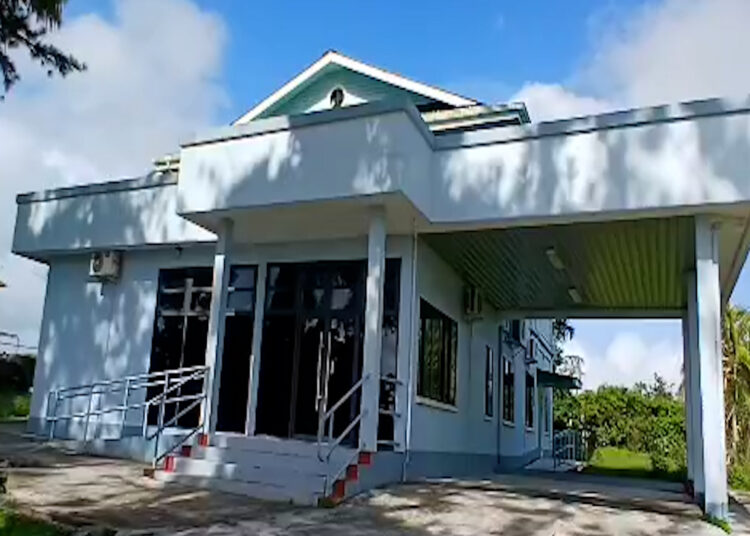
Bartica, one of the country’s fastest-growing townships, now has a modern GLSC office with staff accommodation, while Port Kaituma has received its first-ever GLSC office. The facilities were constructed under the Sustainable Land Development and Management (SLDM) Project, funded by the Guyana REDD+ Investment Fund (GRIF).
According to FAO, the new buildings are intended to strengthen GLSC’s operational presence in Regions One and Seven, improve access to land administration services for communities, and support sustainable land development initiatives at the regional level.
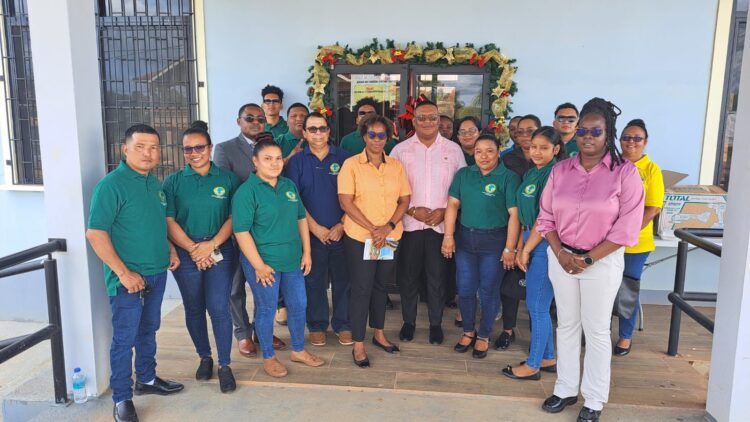
Speaking at the ceremony, Commissioner Monize said the offices will improve the efficiency, transparency and accessibility of land-related services, particularly for mining, forestry, agriculture and Indigenous communities. He highlighted the importance of the Bartica office, noting that over the past five years GLSC has issued 1,255 leases covering approximately 3,202 acres of land and has regularised a significant number of areas in the region. He also expressed appreciation to FAO for its continued partnership under the SLDM Project.
Monize further noted that the new Port Kaituma office represents a major step in meeting the growing demand for land administration services in the area. He pointed out that the facility houses one of the eleven GPS base stations supporting Guyana’s new digitised land surveying platform.
The Port Kaituma building also includes modern staff accommodation on its upper level, aimed at improving working and living conditions for personnel. In addition, boats and all-terrain vehicles (ATVs) were provided to enhance mobility and support service delivery in Port Kaituma and surrounding communities.
Dr. Smith said the Bartica and Port Kaituma offices are part of a broader SLDM investment focused on strengthening institutional capacity, advancing geospatial and land governance systems, and supporting field-level sustainable land management interventions nationwide. She noted that improved physical infrastructure, combined with digital systems and trained human resources, is critical to long-term sustainability and inclusive development. She also thanked GLSC for its partnership and the opportunity to support its vision for decentralised land administration.
At the Port Kaituma ceremony, Regional Chairman of Region One, Brentnol Ashley, described the new office as “a historic milestone for the people of Port Kaituma and the entire Region One.”
“This is not just the opening of an office, but the beginning of a new chapter of access, equity, and opportunity for communities that have long endured challenges due to limited access to essential services,” Ashley said.

He added that residents will no longer be required to travel long distances at significant cost to access land titles, leases, surveys and other critical services. “This means improved service delivery and greater security of land tenure. It means faster processes and empowerment—because land security is fundamental and foundational to housing development, livelihoods, and sustainable community growth,” he said.
With the completion of the Bartica and Port Kaituma facilities, the SLDM Project has now supported the construction of three new GLSC offices—Bartica, Port Kaituma and Black Bush Polder—as well as the renovation of one office and staff accommodation in Mabaruma. FAO said these investments reinforce the Government of Guyana’s commitment to responsible land governance, sustainable development and its obligations under the United Nations Convention to Combat Desertification (UNCCD).