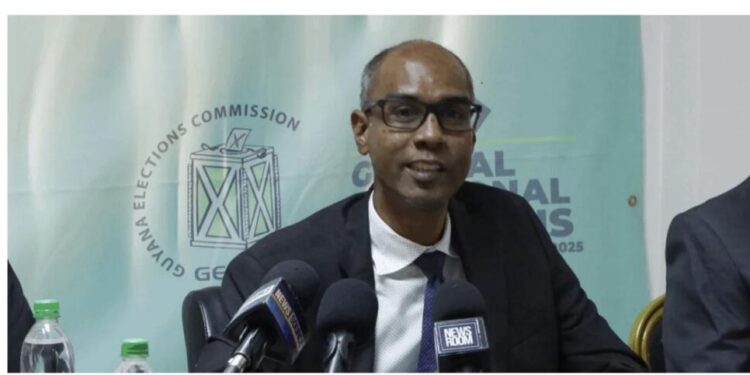
Amid swirling claims of victory, defeat, and razor-thin margins in Guyana’s recently held General and Regional Elections, Village Voice News has been reliably informed that an independent research body, Universal Research, has launched an audit of Statements of Poll (SOPs) from Regions Four and Six — two of the most politically pivotal areas in the country.
The move comes as public confidence in election-related information continues to fracture, with conflicting reports emerging from political parties, social media accounts, and even some sections of the press. Against this backdrop, Universal Research’s audit aims to cross-reference official data against declarations in the public domain, with a view to assessing the credibility of the results expected to be announced by the Guyana Elections Commission (GECOM).
According to information obtained by this publication, the research agency is acting on behalf of international clients with economic and geopolitical interests in Guyana. These clients, sources say, are closely monitoring the country’s political climate and are particularly concerned with the stability of Guyana as a destination for investment.
Speaking on the condition of anonymity, a staff member of Universal Research told Village Voice News that while data could be obtained from local political parties and GECOM, the agency opted for an independent audit as the more reliable course of action.
“There is too much noise in the system right now,” the source said. “The information circulating doesn’t always match the facts on the ground. We believe an external, data-driven audit offers a more objective picture of what is really unfolding.”
The staffer also noted that the audit is focused not only on verifying the numerical accuracy of the SOPs but also on testing the integrity of the electoral environment — including whether any anomalies point to systemic weaknesses, manipulation, or potential voter suppression.
Guyanese citizens went to the polls on Monday, September 1, 2025, and GECOM has since indicated that final results are expected by September 4. However, the period between the vote and the declaration has already been marked by premature victory claims, partisan rhetoric, and mounting public scepticism.
In light of this, Universal Research’s intervention may prove significant — both in terms of adding an independent layer of verification and in exposing potential discrepancies in the information being disseminated to the public.
Though GECOM remains the constitutionally mandated authority for conducting elections, the very need for a foreign-commissioned audit by an independent agency raises questions about confidence in local mechanisms, transparency in the tabulation process, and the reliability of public narratives being shaped in real time.
As one observer familiar with the audit process remarked, “What people are seeing and what’s actually happening may be two different things. That’s why the numbers matter — and where they come from matters even more.”
Universal Research did not confirm or deny to this publication if its findings will be made public. But in an environment where public trust is increasingly fragile, such efforts may help shine light on a process many believe is currently unfolding in shadows.