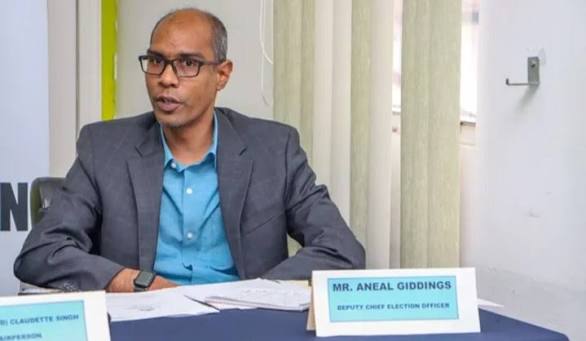
In a tense development surrounding the upcoming elections, the Guyana Elections Commission (GECOM) has found itself in a legal quagmire after its Chief Election Officer (CEO), Vishnu Persaud, repudiated submissions made by the commission’s legal officer, Kurt Da Silva, regarding voter eligibility for regional elections. The issue centers around the residence requirements for regional voters, with Persaud asserting that the legal officer’s comments were unauthorised and at odds with the instructions he had provided.
Persaud, in a statement issued Friday, expressed dismay over the submissions made by Da Silva, particularly the suggestion that separate ballots should be used for General and Regional elections to ensure that voters for regional elections meet the required residency qualifications. “The pronouncements made by the Legal Officer do not represent my instructions and were unauthorised,” Persaud said, emphasizing that they were disconnected from the case at hand. The CEO’s statement confirmed that GECOM is now waiting for a ruling from the High Court, which is expected to be delivered by March 28.
The controversy stems from a case filed by Carol Smith-Joseph, a member of the People’s National Congress Reform (PNCR), challenging the application of residence requirements for regional elections. Persaud’s rejection of the legal officer’s proposal comes at a critical time, as the court’s ruling could have wide implications on the process for the upcoming elections. Smith-Joseph is being represented by Senior Counsel Roysdale Forde.
Despite the CEO’s objections, legal experts suggest that GECOM may not have much to fear from the outcome of the High Court’s ruling. They anticipate that the decision will likely be broader in scope, addressing multiple constitutional provisions related to voter qualifications, rather than being confined solely to the issue of residence for regional elections.
Attorney General Anil Nandlall, representing the State, argued in court that Articles 59 and 159 of the Constitution, which outline the qualifications for voting, take precedence over Article 73, which requires voters for regional elections to reside in the administrative region where they are voting. “The Constitution must be read as a whole, with governing provisions prevailing over those that are subordinate,” Nandlall argued, emphasizing that the Constitution should be interpreted in its entirety to achieve the true meaning of its provisions.
Da Silva, in response to submissions from the PNCR’s Chief Scrutineer, explained that prior to the 2022 amendments to the National Registration Act (NRA), voter residency was verified for all individuals registering to vote. However, with the amendments, which clarified that residency is not a requirement for voting in general elections, he recommended that GECOM print separate ballots for the general and regional elections.
DaSilva further suggested that separate lists of electors should be generated for the two elections, as some individuals, such as Guyanese citizens living abroad, may be eligible to vote in general elections but not in regional elections.
Citing these changes, Da Silva emphasised the need for clear distinctions between the two sets of voters, especially given that claims and objections related to voter lists would be based on different criteria for each election. For regional elections, residency would be a factor, while for general elections, it would not apply to citizens living outside Guyana.
Persaud, however, strongly criticised Da Silva’s comments, warning that such statements could create confusion and undermine preparations for the elections. He expressed concern that the legal officer’s pronouncements were at odds with how voter lists and ballots had been prepared in previous elections, including the 2020 general and regional elections. “The Legal Officer’s pronouncements create uncertainty and could mislead stakeholders, including voters, political parties, and international observers,” Persaud said.
He also reassured the public that the views expressed by Da Silva did not reflect his own instructions. “I categorically state that the Legal Officer’s pronouncements do not represent, in any way, shape, or form, my instructions to him,” he added.
Meanwhile, GECOM is now left awaiting the High Court’s decision, which could have significant implications for the upcoming elections, particularly regarding the handling of voter eligibility and the process for verifying residency in the context of regional elections.