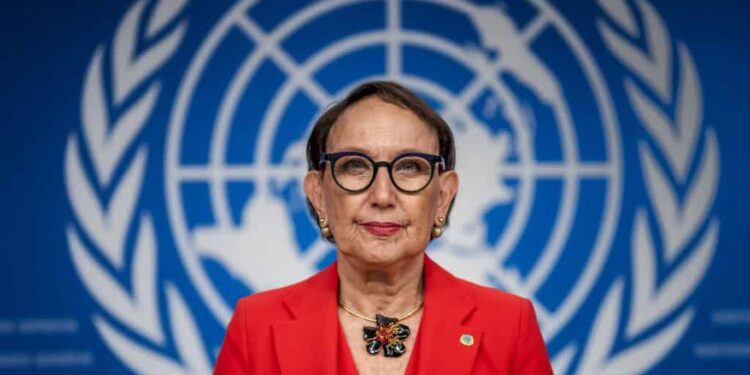
(CNS) — South-South cooperation is a powerful tool in supporting children’s health, education and protection, Amakobe Sande, the United Nations Children’s Fund (UNICEF) Representative to China, told China News Service in an interview.
Projects that China has undertaken with UNICEF in Africa show what can be achieved through South-South cooperation, which brings tangible benefits to children.
According to Sande, Africa has made significant strides in recent decades on child survival and development. However, due to a polycrisis that is characterized by climate change, regional conflict, and the COVID-19 pandemic, many urgent needs for children are yet to be met, including providing health services, addressing malnutrition, ensuring access to safe water and sanitation, and tackling the learning crisis.
She cites some examples to make her point clear. Children born in sub-Saharan Africa remain at the highest risk of childhood death in the world. In 2021, sub-Saharan Africa accounted for 56 percent of all under-five deaths in the world. In terms of immunization, half of the 20 countries in the world with the largest number of zero-dose children are in Africa. Meanwhile, climate-induced emergencies and conflicts have displaced millions of children and pushed them out of school.
To address these challenges, Sande said that the Chinese government has funded UNICEF programmes for children in 16 countries in Africa – including her home country of Kenya.
UNICEF is working with the Chinese government to implement maternal, newborn and child health programmes in eight African countries including Democratic Republic of the Congo, Ethiopia, and Kenya. This also includes training for local health professionals.
“The training feedback was overwhelmingly positive: 94 percent of respondents reported that their knowledge had improved,” said Sande. These programmes fully leveraged China’s achievements in maternal, newborn and child health to help reduce the deaths of mothers, newborns and children under the age of five, and to promote exchange and cooperation between China and African countries.
In July this year, UNICEF signed a memorandum of understanding with the China Center for Disease Control and Prevention, which aims to mobilize resources to improve primary healthcare systems in Africa.
Sande believes that this cooperation will not only help prevent infectious diseases and build a reliable health supply chain in Africa but also train health workers to collect data on health and diseases and explore innovations in the digitalization of health services.
Sande noted that Africa has the youngest population in the world. However, it is also the continent with some of the most significant challenges in accessing digital platforms. Many African countries lack the necessary infrastructure and digital solutions to support widespread internet access and digital learning.
She pointed out that China has made significant advancements in digital education and become a global champion for the Gateways to Public Digital Learning Initiative, a global initiative, collaboratively managed by UNICEF and UNESCO. These actions will help close the digital divide and make sure that more children and young people in Africa can benefit from digital learning opportunities.
The 2024 Forum on China-Africa Cooperation (FOCAC) Summit is soon to be held in Beijing, with the theme of “Joining Hands to Advance Modernization and Build a High-Level China-Africa Community with a Shared Future.”
“This will be my first time attending the FOCAC Summit in Beijing as UNICEF Representative to China. I also participated in two previous FOCAC summits in a different capacity,” she said.
From herSande’s perspective, this summit is an important platform for strengthening South-South cooperation between China and Africa, and ensuring that the needs of vulnerable groups such as children and women are prioritized in international development cooperation. “I hope that the summit will add to the momentum for sustainable growth and modernization that benefits children and families.”
She hopes, in particular, to see five key areas articulated. First, investing in human capital development, in line with Africa’s Agenda for Children 2040 and the African Union Agenda 2063. Second, enhancing health systems, to make health care more resilient and equitable. Third, investing in education to set up digital education infrastructure, with affordable internet connectivity, learning platforms and devices. Investment should also, and to build young people’s vocational skills. Fourth, addressing malnutrition and food security, and sharing China’s successful experiences in providing fortified complementary food supplements to children. Fifth, investing in essential services for children and ensuring they are built to be climate-smart and resilient during climate induced emergencies.
UNICEF became a permanent part of the United Nations system in 1953, when our name was shortened to the United Nations Children’s Fund. However, UNICEF retained its original acronym.