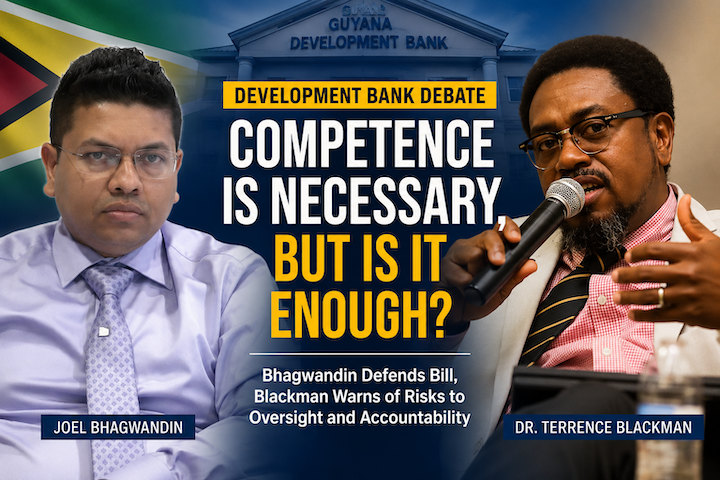
A public debate over the proposed Guyana Development Bank intensified this week after economist Joel Bhagwandin defended the institution’s governance framework, only to face a detailed rebuttal from mathematician and public commentator Dr. Terrence Blackman, who argued that the legislation concentrates too much power in the hands of the executive and lacks adequate safeguards.
Writing in response to concerns raised about the Development Bank Bill, Bhagwandin contended that the proposed institution should be governed by competence rather than politics. He argued that the bank’s board should comprise professionals with expertise in banking, finance, economics, law, agriculture and technology, rather than representatives from opposition parties or civil society.
“The Guyana Development Bank is not conceived as a political institution; it is a financial institution with a development mandate,” Bhagwandin wrote. “A development bank should be governed on the basis of competence, fiduciary judgment and relevant sectoral expertise.”
Bhagwandin further dismissed concerns that the absence of opposition and civil society representatives on the board would weaken oversight. He argued that accountability would be ensured through annual reports and audited financial statements being tabled in the National Assembly, making the bank subject to parliamentary and public scrutiny.
He also defended the Bill’s flexible structure, arguing that lending criteria and operational details are more appropriately contained in internal credit and operational manuals rather than rigidly prescribed in legislation.
However, Blackman, writing from Brooklyn, New York, challenged what he described as a fundamental flaw in Bhagwandin’s argument. While agreeing that competence, oversight and institutional discipline are essential, Blackman argued that the legislation as drafted fails to adequately guarantee any of them.
“The disagreement is not about whether a development bank should be run by professionals,” Blackman wrote. “It is about whether this framework actually secures what Mr. Bhagwandin says it secures.”
At the centre of Blackman’s critique is the Bill’s provision allowing the Minister of Finance to appoint all directors, including the chairperson and deputy chairperson.
“Competence sourced entirely from one appointing authority is not independence; it is concentration wearing a credential,” Blackman argued. “The ‘professionals versus politics’ frame collapses the moment one political office selects all the professionals.”
According to Blackman, critics of the Bill are not necessarily advocating for opposition representation for its own sake but rather for mechanisms that prevent any single political actor from exercising complete control over an institution tasked with allocating billions of dollars in public capital.
Blackman also rejected Bhagwandin’s contention that parliamentary reporting requirements constitute sufficient oversight. He described the tabling of annual reports as “ex-post disclosure” that informs the public only after decisions have already been made.
“It is not supervision,” Blackman wrote. He noted that the proposed bank would not be subject to the same continuous prudential oversight by the Bank of Guyana that applies to other financial institutions.
The issue of flexibility also emerged as a major point of contention. Bhagwandin praised the Bill’s reliance on internal operational manuals rather than detailed statutory requirements. Blackman countered that such flexibility creates opportunities for future manipulation.
“Flexibility and discretion are the same quantity viewed from opposite sides,” he wrote. “Moving those rules out of legislation and into an internal credit manual does not eliminate them; it relocates them to where they can be rewritten without parliamentary friction.”
Blackman further argued that institution-specific safeguards such as conflict-of-interest rules, related-party lending restrictions and procurement requirements should be explicitly embedded in the legislation rather than relying solely on broader anti-corruption laws.
The debate comes amid growing public discussion about the government’s proposal to capitalize the Development Bank with an initial $40 billion. Critics have raised concerns about governance, accountability and the potential for political influence in the allocation of loans and investment capital.
Blackman suggested that public confidence in the institution will depend not on the qualifications of those appointed to manage it but on whether the structure itself can withstand changes in political administration.
“The right test is whether that framework would survive a change of government, whether it is built so that no party, this one or the next, could turn it into an instrument,” he wrote.
He concluded with a warning that institutions handling large sums of public money should not be built on assumptions of goodwill.
“A design that depends on the good faith of whoever holds power is not a framework,” Blackman said. “It is a wager.”
The exchange reflects broader concerns among sections of the public over how Guyana’s growing oil wealth should be managed and whether new state institutions are being designed with sufficient safeguards to ensure transparency, independence and public trust.