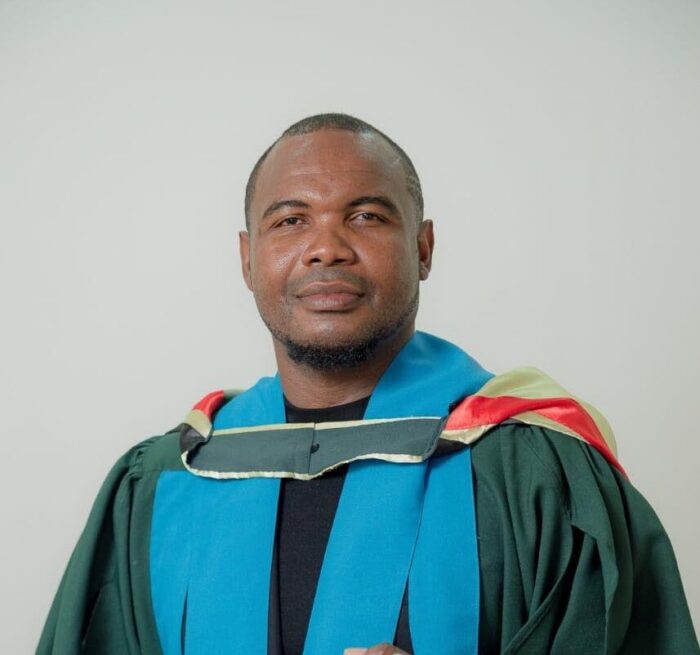
Dr. Gordan Barker, an educator holding a Master of Education and a Doctor of Philosophy, and Member of Parliament for We Invest In Nationhood (WIN) as Shadow Minister of Education, delivered a pointed and rigorous examination of the 2026 National Budget during the opening day of parliamentary debates on Monday. Stressing the need for transparency, accountability, and meaningful regional development, Dr. Barker urged the People’s Progressive Party/Civic (PPP/C) government to ensure that budget allocations translate into tangible improvements for schools, teachers, and learners.
“It is indeed a privilege and an honour for me to rise in this National Assembly…the collective will of the Guyanese people is represented, debated, and translated into policy,” Dr. Barker said, noting the solemn responsibility that rests on every member of the House to act in the nation’s best interest.
The 2026 Estimates, he noted, present a budget of unprecedented scale, totaling approximately $1.558 trillion. “A Budget of this magnitude carries with it an equally significant burden of accountability,” he said, questioning, “Where is the money going? Who benefits directly?”
Focusing on education, Barker emphasised its role as a driver of social mobility, national cohesion, and economic development. He highlighted the Ministry of Education’s allocation of $183.6 billion but expressed concern over critical gaps affecting teachers and students. “No education system can rise above the quality, morale, and stability of its teachers…Backlogs in promotions, delays in confirmations, and lack of risk allowances remain unaddressed,” he said.
He also questioned the efficacy of the National School Feeding Programme, which provides $61,000 per child annually to approximately 115,000 students. “With the number of reported cases about the quality of the meals being provided, it is better to provide the parents of these children with that additional $61,000 a year,” he argued.
Turning to capital investments, Dr. Barker criticized the lack of transparency in school rehabilitation and construction projects, particularly in Region 3 (Essequibo Islands–West Demerara), where he serves as Regional Representative. “Nowhere in Volume 3 are we provided with a transparent, region-by-region breakdown of which schools will be built, expanded, or rehabilitated in 2026…Inference is not accountability. And inference does not build classrooms,” he said.
He detailed ongoing challenges in Region 3 schools, including overcrowded classrooms, inadequate sanitation, flood-prone compounds, and insufficient teacher support. Dr. Barker also raised concerns over bullying and student violence. “Our teachers are already struggling to make ends meet with the unlivable salaries they receive…Now they have to endure physical attacks by learners,” he stated.
Despite billions allocated to scholarships and programme development, the initiative has relied heavily on overseas partnerships rather than fully empowering local institutions. This has led to disputes over course credibility, including a rupture with the University of Staffordshire, leaving approximately 1,400 students uncertain about the validity of their programmes, access to learning platforms, and pathways to degrees.
While GOAL maintains it is expanding access to education, the disruption highlights gaps in oversight, programme management, and accountability, raising concerns about whether public funds are achieving sustainable local educational impact.
Barker, in his presentation noted that, “Students have been left in limbo…This programme has become a symbol of poor planning, weak oversight, and unacceptable uncertainty for thousands of Guyanese,” he said.
He further emphasised the importance of aligning education with regional economic realities, citing Region 3’s role as a hub for the Gas-to-Energy Project and a growing residential and industrial corridor. “We cannot build an energy economy with an education system that is disconnected from workforce planning,” he noted, stressing that the Estimates treat key sectors—education, agriculture, public works, and health—as silos, despite their daily intersections on the ground.
Concluding his address, Dr. Barker called for a people-centered approach that prioritizes regional delivery and measurable outcomes. “A Budget that claims to put people first must ensure regions, schools, teachers and learners are made priority…Without clear school-level plans, outcome targets, and regional strategies, this House is asked to approve an education agenda that sounds ambitious, but remains difficult to track, test, or hold accountable,” he said.