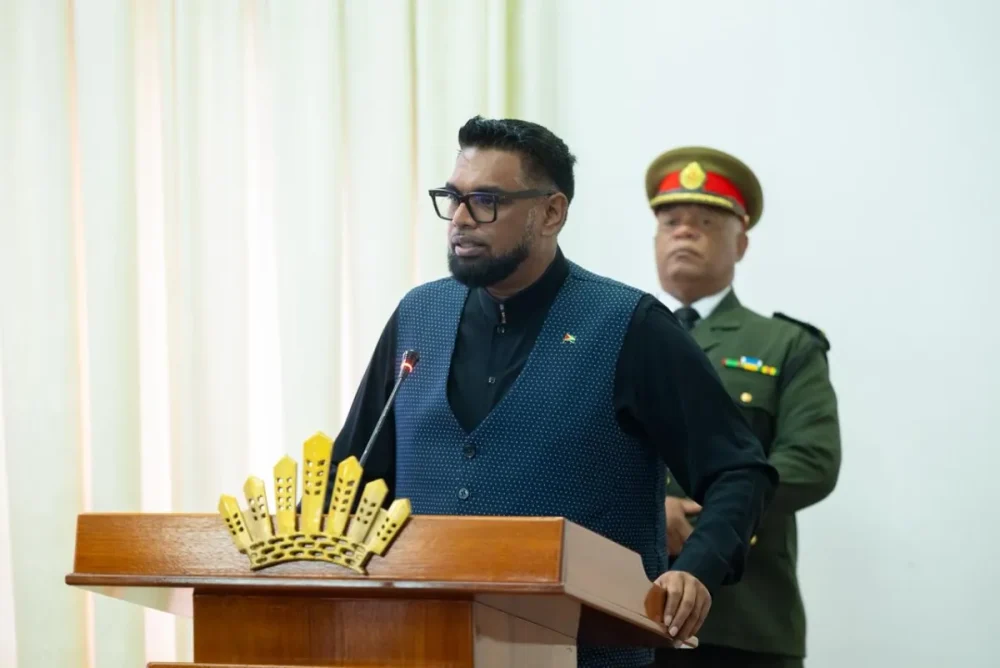
President Irfaan Ali on Thursday administered the oath of office to Regional Chairpersons and Vice Chairpersons for nine of Guyana’s ten administrative regions—while Region 10, still deadlocked from a 9–9 tie in its October 10 leadership vote, remained conspicuously absent from the ceremony.
Speaking at the Arthur Chung Conference Centre (ACCC), President Ali reiterated his call for “people-centred” governance, a development philosophy he has increasingly promoted. However, political observers and opposition figures note that the term predates the administration’s recent usage and has long been central to A Partnership for National Unity’s (APNU) approach to governance—raising questions about whether the government is echoing, rather than originating, the community-driven framework it now highlights.
The President told newly sworn-in officials that the administration of the oath is a solemn commitment to citizens.
“This ceremony is a reaffirmation of the democratic covenant between the elected and the electorate. Leadership is not an entitlement; it is a trust,” he emphasised.
Citing Section 75 of the Local Democratic Organs Act, the President underscored the legal requirement for all regional leaders to take the prescribed oath before functioning in office. He reminded the gathering that RDCs, though autonomous, operate within the constitutional fabric of a unified Republic.

Ali stressed that effective governance must be decentralised and responsive, given Guyana’s size, diversity, and rapid transformation.
“RDCs bring government directly to the people,” he said, pointing to their responsibilities in health, education, agriculture, infrastructure and community development. “Your mandate reflects the unique needs and character of each region.”
The President called for political cooperation after the September RDC elections, stating: “The competition has ended. Cooperation must now prevail… The people have given you a mandate to build, not to divide… to deliver, not to stall progress.”
He added that citizens expect more efficient services, naming better roads, streetlights, garbage collection, neighbourhood safety and improved water and sanitation among the areas requiring urgent attention. “Our citizens are weary of long waits and slow responses,” he said, urging regional officials to “walk the communities, listen, act and communicate.”
He also announced upcoming government initiatives aimed at improving the working conditions and pay of RDC officials, NDC leaders, CSOs, and other community-based workers.
“We are committed to improving not only your conditions of work but also your pay for work,” the President stated.
But even as Ali pressed for accelerated delivery across the ten regions, Region 10 still has no Chairperson or Vice Chairperson to carry out those responsibilities. The 9–9 tie between candidates on October 10 triggered a legal deadlock that requires a second round of voting. Despite this clear pathway under the Local Democratic Organs Act, the administration has not facilitated a follow-up vote, effectively preventing Region 10’s duly elected council from completing its leadership process.
The absence of Region 10’s leadership at the swearing-in ceremony underscored the unresolved impasse and heightened concerns about equitable regional governance. Opposition figures argue that while the President speaks about people-centred development, the ongoing refusal to move toward a lawful tie-breaking vote contradicts the inclusivity and fairness such an approach demands.