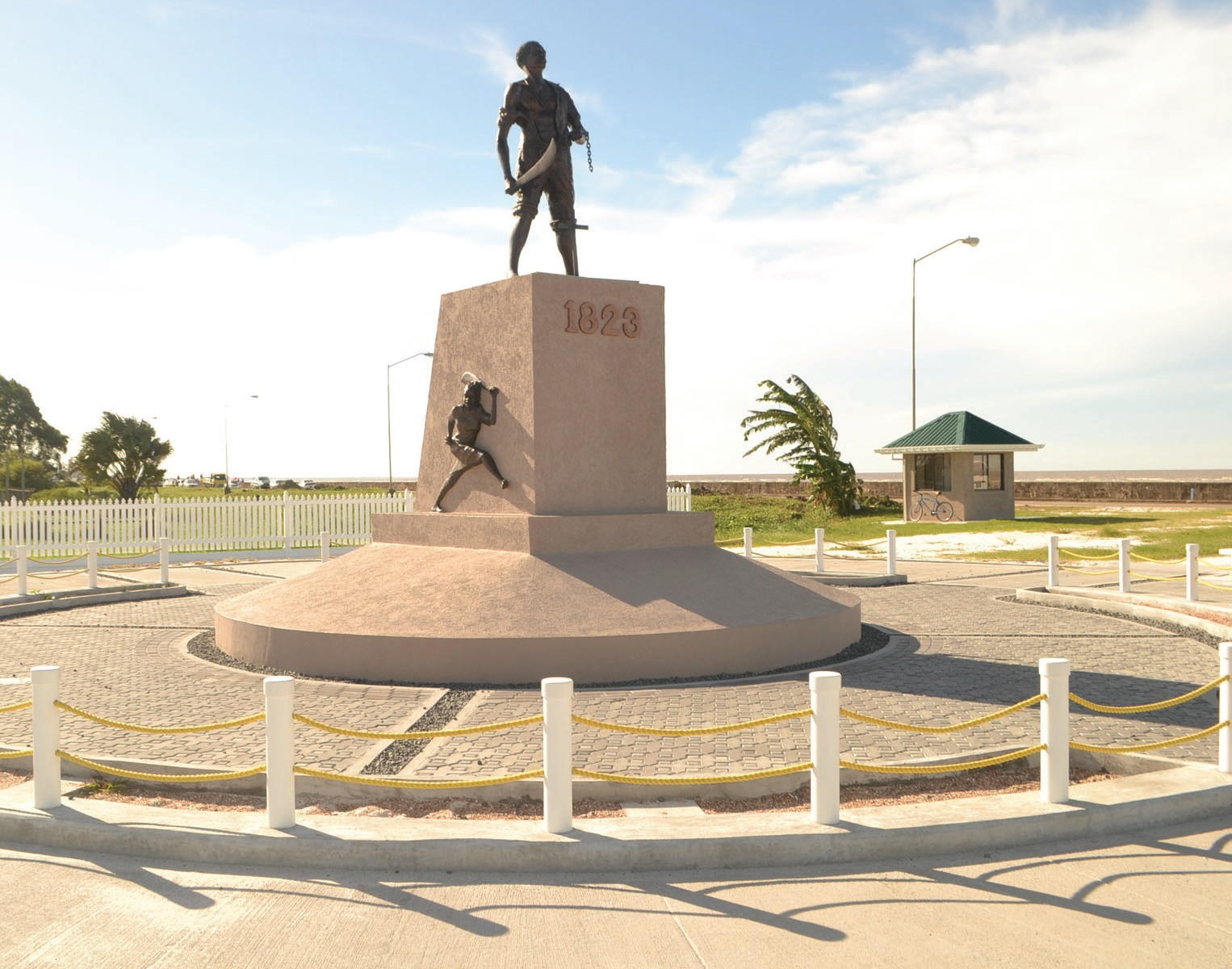
| By Winston McGowan- The 1823 Demerara uprising has several distinguishing features. Firstly, it is one of only two major slave rebellions in Guyanese history, occurring sixty years after the better-known Berbice slave insurrection of 1763, led initially by Kofi. Slave revolts, in fact, were a relatively rare feature in the history of most slave societies in the Americas. This rarity was due largely to the fact that slaves were influenced by three considerations. They were aware not only that it was extremely difficult to plan and organise a rebellion without detection, but also that revolts were likely to fail and the participants would incur severe punishment.
In 1823 some slaves in Demerara knew that there had only been one slave uprising that had succeeded in overthrowing slavery and White rule, namely, the revolt which had broken out in the French colony of Saint Domingue in 1791 and resulted by 1804 in the creation of Haiti, the first black state in the Americas. Furthermore, fear of failure, prompted partly by the memory of an unsuccessful slave uprising in Barbados in 1816, caused some slaves on the East Coast of Demerara in 1823 to refuse to participate in the rebellion.
A second distinctive feature of this Demerara uprising is that it is one of the most massive slave rebellions in the entire history of slavery in the Americas. It is estimated that 11,000 to 12,000 slaves from about 55 plantations between Liliendaal and Mahaica participated in the revolt. Massive uprisings involving thousands of slaves were extremely rare in the Americas. This was because of the immense difficulty encountered in organising a revolt secretly over a wide area without detection by the pervasive mechanisms of surveillance and control employed by the slave-owning class. Thus the largest slave uprisings in Brazil, arguably the country in the Americas which witnessed the most slave rebellions, involved only 600-700 slaves. In fact, the only slave revolts in the Americas which definitely had more participants than the 1823 Demerara uprising were the successful rebellion in Saint Domingue between 1791 and 1804 and a rebellion at Christmas in Jamaica in 1831.
The 11,000 -12,000 slave rebels on the East Coast of Demerara in 1823 constituted about 1/6 or 1/7 of the entire slave population of about 75,000 of what was then called the United Colony of Essequibo and Demerara. Though the number of rebels in 1823 was greater than those who participated in the famous rebellion in Berbice sixty years before, the proportion of slave rebels in Berbice in 1763 was larger. In 1763 the colony of Berbice had an estimated slave population of about 3,800, of whom at least 75 per cent are believed to have been involved in the rebellion. In short, in 1763 Berbice experienced what can be described as a colonial or almost total revolt.
In striking contrast, in 1823 the uprising was restricted to only one area of the colony of Demerara-Essequibo, namely, the East Coast of Demerara. Slaves in the other parts of the colony did not participate, although the leaders of the rebellion hoped to obtain support from slaves at least on the West Coast of Demerara.
The rebellion was also distinguished by the fact that Christianised slaves played a prominent role. Among its leaders and other participants were deacons, class teachers, and other members of Bethel Chapel, a church established on Plantation Le Resouvenir in 1808 by
White missionaries sent by the London Missionary Society in England to inaugurate the Christianisation of slaves in Demerara.
One of the main grievances of these slaves was the imposition of restrictions on the practice of their religion by their masters, who refused give them permission to attend church or hold religious meetings on their plantations night. They were also prompted to rebel by the effect of certain Christian teaching, especial the doctrines of the equality of man in the sight of God and Christian brotherhood.
These doctrines gave the slaves an enhanced value of their self-worth, which seemed to be no longer compatible with the subordination, injustice and cruelty of slavery. This view was reflected in the remarks made by a group of them to Governor Murray at the beginning of the revolt that they wanted “their right … God had made all men of the same flesh and blood. They were tired of being slaves.” This was the first occasion in the history of the Caribbean that Christianised slaves played a leading role in a rebellion.
Another striking feature of the Demerara rebellion was the remarkable degree of restraint, self-control and humaneness demonstrated by the rebels. Although they had ample opportunity, particularly during the first two days of the revolt, to kill most of the Whites ‒ proprietors, attorneys, managers, overseers and book-keepers ‒ on the East Coast, the slaves for the most part merely seized them and placed them in the stocks without harming them. They hardly offered personal violence against any White, especially where they met no resistance. On a few plantations where Whites opposed them with firearms, they returned fire. These rare clashes resulted in the death of two and the injury of four White estate personnel defending their plantations.
This virtual absence of the shedding of the blood of Whites during the rebellion was attributed by the slaves to the effect on them of religious instruction which they had received at Bethel Chapel. They explained: “We will take no life for our pastors have taught us not to take that which we cannot give.” In striking contrast, however, the White troops, especially those led by Colonel Leahy, ruthlessly suppressed the rebellion with a savagery which horrified the White civilian volunteers who served with them.
Perhaps the most distinctive feature of the uprising was that many slave-owners on the East Coast of Demerara believed that the main instigator of the rebellion was a White man, John Smith, the minister at Bethel Chapel (on the third day Smith was arrested and charged with several offences, including inciting the slaves to rebel. He was tried, declared guilty and sentenced to death by hanging. The sentence was referred to the British government for confirmation. In February, 1824, however, Smith died from illness in prison in Georgetown, while a response was on the way from England granting him a reprieve, but ordering his deportation there.
No previous slave uprising in the Caribbean had had such a calamitous end for a respectable White man at the hands of his fellow Whites. However, Smith’s death eventually had considerable significance. The memory of the 1823 uprising, particularly the death of a White minister of religion, helped to attract attention in England inside and outside of Parliament to the necessity of eliminating the terrible evil of slavery. This played a part in influencing the momentous decision made in 1833 to abolish slavery in the British Empire with effect from 1st August 1834. (Stabroek News)
|

MV Barima: 79 Lives Lost, Government Accountability Still Missing- GHK Lall
By GHK Lall- I applaud civil society groups for their calls re the MV Barima tragedy. I endorse sending ministers...
Read moreDetails